
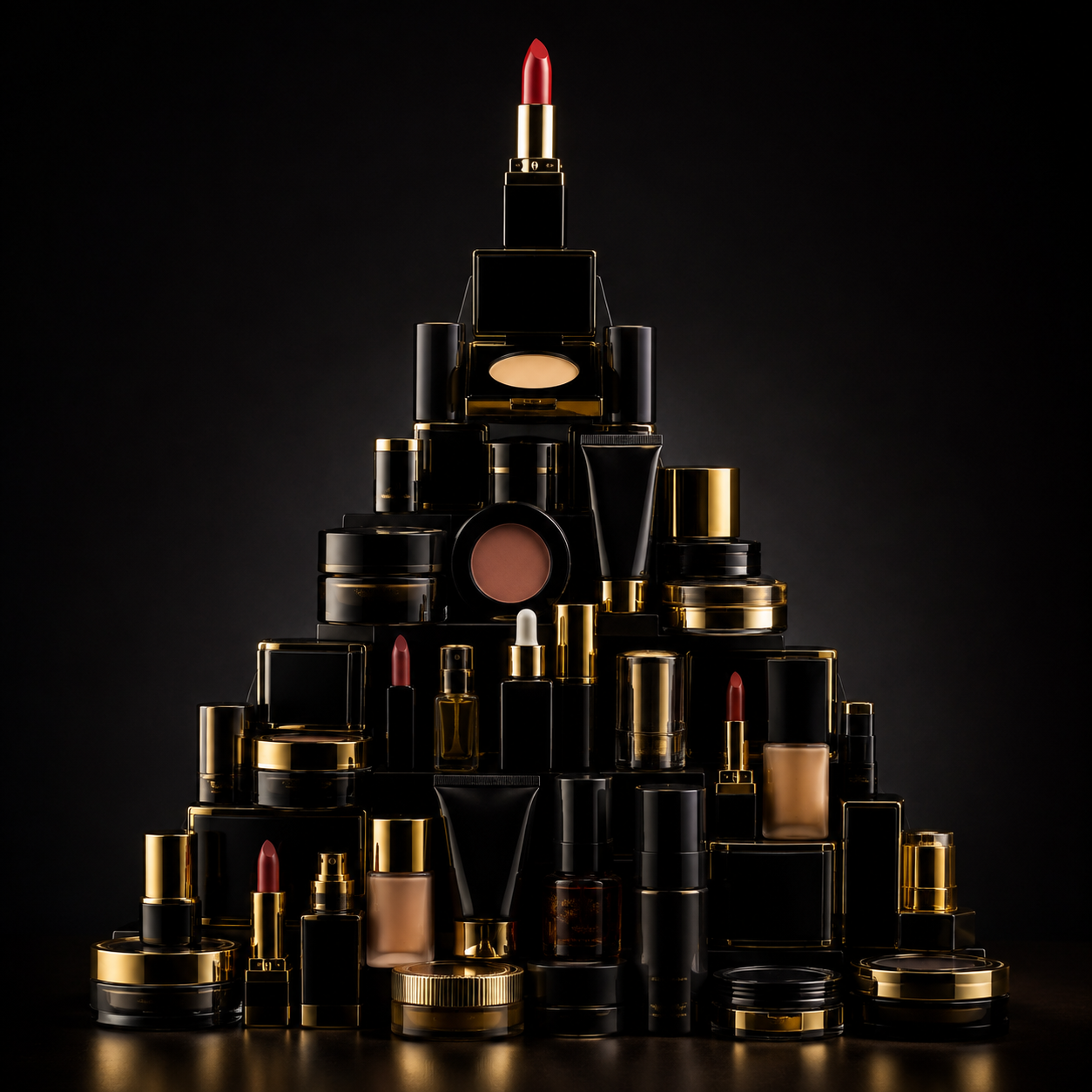
My Multi-Level Pyramid Problem
Nothing makes me happier as a teacher than seeing my students become successful in the field I introduced them to. And when a former student reaches out, I am always happy to reconnect, catch up, and hear where life has taken them.
Recently, a former student who has built a long-standing career for herself in the beauty world reached out, telling me she had something extremely exciting to share.
Nothing makes me happier as a teacher than seeing my students become successful in the field I introduced them to. And when a former student reaches out, I am always happy to reconnect, catch up, and hear where life has taken them.
Recently, a former student who has built a long-standing career for herself in the beauty world reached out, telling me she had something extremely exciting to share.
As the teacher who first introduced her to makeup, naturally I became excited. Perhaps she wanted to collaborate on an educational project. Maybe she wanted me to travel somewhere as a guest speaker. Within a few minutes, apparently I had already mentally accepted my Oscar.
The next morning, I answered her message, thanked her for reaching out, and asked what this exciting news was all about.
The exchange began innocuously enough: a few how-are-you’s, some catching up. Then she pivoted and asked whether I had heard of a beauty brand called Riman.
I had not.
She began telling me how much she loved the products, the colours and textures, how South Korean beauty continues to expand globally, and how well she had been doing financially selling the line. The company, she explained, was interested in expanding into my region, which naturally made her think of me.
As she was writing, I began researching the company myself.
And looking for the catch.
The product line appeared relatively straightforward, positioned at a fairly premium price point and frequently offered in bundled groupings. More importantly, the company operates through a multi-level marketing structure in which sellers can earn commissions on product sales and, potentially, through the recruitment and sales activity of other representatives.
This is where my heart sank.
I have always been deeply uncomfortable with this type of business model.
Not because selling products is inherently distasteful. I have worked in beauty for more than three decades. Selling, recommending and introducing products is part of the industry, I know the game well.
What troubles me is what happens when the people around you slowly begin to look less like friends, relatives, colleagues or former teachers—and more like potential customers.
Family. Friends. Lovers. Coworkers.
Everyone becomes a prospect.
And then we wonder why certain family members stop getting invited to events.
Multi-level marketing has existed in beauty for decades. Brands such as Mary Kay, Avon and Arbonne have all used variations of direct-selling or representative-based business models, and these structures have long generated debate about recruitment, market saturation, income potential and the pressure placed on personal networks.
I have been approached several times over the years to represent or sell companies operating this way. I have also watched friends invest substantial amounts of money into products that eventually sat untouched on shelves—unsold, unwanted, unloved and unnecessary.
What bothers me most, however, is the recruitment aspect.
The promise is often not simply that you can make money selling a product. The appeal becomes that you can bring other sellers into the structure and potentially benefit financially from their activity as well.
And that changes the nature of the interaction.
What bothered me about hearing from my former student was not simply being offered a beauty product. PR representatives offer me products regularly; that is part of my professional life.
What bothered me was realizing that a relationship I associated with mentorship, history and genuine affection had become the doorway to a commercial opportunity.
Perhaps she sincerely thought of me because she believed I would be good at it. I am willing to give her that generosity.
But that is also exactly what troubles me about this type of business model: it encourages people to look at their relationships and see potential markets.
I cannot begin to describe how strange it felt to have a former student approach me with an opportunity from which she might ultimately benefit financially, knowing that it was my own knowledge, patience and teaching that had helped introduce her to this industry in the first place.
The gall. The gumption.
And, admittedly, the irony.
I understand the temptation. We live in a world where everyone is trying to do too much yesterday, increase their revenue, maximize their time and create additional streams of income.
I am trying to do exactly the same thing.
But there must be ways to generate revenue without cannibalizing our social circles and turning every person we know into a potential client.
In the end, I politely declined.
I told her that I was happy she had found something that worked for her, but that I was not interested in investing in another beauty brand.
Right now, I need to invest in myself.
And since we were apparently discussing professional opportunities, I asked whether she might be willing to write a testimonial about her experience studying with me.
She very kindly said yes.
At the time of writing, I am still waiting.
Perhaps there is a lesson in that too.

The Beauty Industry’s Dirty Secrets
The beauty industry keeps growing, showing no signs of slowing down. Its current global value sits at over 500 billion dollars and is expected to grow another 5% by 2030.
And in a world full of economic bubbles and instability, it’s oddly comforting to know that beauty thrives even in periods of uncertainty.
But here’s the truth no one likes to say out loud:
Behind the glamour and luxury lies a system built on half-truths, inflated narratives, and carefully hidden tricks.
The beauty industry keeps growing, showing no signs of slowing down. Its current global value sits at over 500 billion dollars and is expected to grow another 5% by 2030.
And in a world full of economic bubbles and instability, it’s oddly comforting to know that beauty thrives even in periods of uncertainty.
But here’s the truth no one likes to say out loud:
Behind the glamour and luxury lies a system built on half-truths, inflated narratives, and carefully hidden tricks.
Beauty has become a currency — a requirement, even — in a culture obsessed with looks-maxing and aesthetic perfection. And with demand higher than ever, brands have never enjoyed such a steady stream of paying clients. Children using adult actives, teens contouring like seasoned pros, men wearing boy makeup… It’s a frenzy.
And when there is frenzy, corporations act accordingly.
As someone who has loved beauty all my life — and worked directly with many of these influential brands — I’ve seen more than enough to be wise to the tricks. And what better time than Black Friday madness to help my readers navigate the dirty little secrets of the beauty industry?
Let’s begin.
Companies Only Sell the Beauty
What most clients don’t realize is that very few beauty brands actually manufacture their own products.
In many cases, the formulas belong to their suppliers. Companies then tweak them — a new fragrance, a waterproof version, a long-lasting finish — and sell them as entirely unique innovations.
Meaning:
your favorite luxury product could be nearly identical to a drugstore formula from another brand using the same supplier.
Once you know this, a lot makes sense.
Corporations Who Own Multiple Brands
Owning multiple brands isn’t inherently unethical. Where the problem begins is in the fine print.
When a large company acquires a smaller one, they also buy the formulas. They can then repackage these formulas and sell them across multiple brands at different price points.
That incredible high-end mascara?
It may be almost identical to the drugstore version — perhaps with a different fragrance and fancier packaging.
Which brings us to…
You’re Paying for Packaging First
High-end brands are the guiltiest here.
That elegant compact with the magnetic clasp?
The packaging alone often costs more than double the cost of the product inside it.
Sometimes the decorative box — the wrapping — costs more than both the packaging and the product combined.
Luxury often means:
you’re paying for the box, not the formula.
Reformulations Are Always a Bad Sign
Brands will tell you that reformulations mean:
better ingredients
less irritation
improved performance
But the truth is usually more practical — and far less glamorous.
Often an ingredient becomes unavailable, too expensive, or worse: illegal (think the recent talc issues). And when reformulations happen, you’ll notice two things every single time:
The amount of product decreases.
The price increases.
That’s what “progress” looks like for a corporation.
What Really Happens When Brands Grow Bigger
Whenever a new beauty brand begins having widespread success, one of the major beauty retailers inevitably takes notice and offers them a section or gondola in their stores.
For beginning brands, this feels like a lifeline — access to a wider audience, increased visibility, and a kind of validation that says: you’ve made it.
But along with this opportunity comes a hidden cost.
Large retailers take a significant cut of the brand’s profits. To compensate, many companies begin quietly reducing the cost of their formulations — cheaper base ingredients, less expensive actives, modified textures.
In other words:
the product changes long before the brand ever admits it.
This is why when smaller brands expand nationwide or globally, their original loyal customers often notice something is “slightly off” in the products they once loved.
They’re not imagining it.
Behind the scenes, the formula has been altered to increase profit margins under the weight of retail demands.
Using Rare Botanical Extracts
Higher-end skincare brands love this trick.
They know most consumers can’t read — or don’t know how to interpret — ingredient lists. Rare botanical extracts sound luxurious, but here’s the catch:
They often appear in very low percentages (far too low to be effective).
Some botanical extracts can actually cause reactions.
The ingredient list is ordered by concentration — so if the extract is at the bottom, it’s marketing, not science.
Green tea is a wonderful antioxidant, yes.
But if there’s barely 2% in your cream, do you truly think it will change your skin?
Fragrances Today Are More Chemical Than Ever
Companies hide their fragrance blend under a single word — “fragrance” or “perfume.”
The justification is “protecting intellectual property.” The result?
A legal loophole allowing brands to hide dozens of chemicals behind a single word.
You have no way of knowing what’s in that blend.
This is why, in my opinion, the best skincare is fragrance-free. Not as sensual — but far better for the skin.
Another truth:
brands often add strong fragrance to mask the unpleasant scent of their base formula.
If it smells too good to be true… it probably is.
Gift With Purchase
The beauty giants adore this.
Spend more than you planned, and you “earn” a cosmetic bag filled with samples. But:
samples have no retail value
they’re not customized
you’re essentially paying for things you could have received free on counter
and you’re adding another cosmetic bag to the pile
It’s an old tactic — but still wildly effective — for getting consumers to overspend.
Scarcity in Beauty
Manufactured scarcity is one of the industry’s favorite tricks.
Limited editions. Exclusive drops. “Back by popular demand.” All designed to create:
urgency
hype
fear of missing out
Once the product sells out, demand spikes, and companies can raise the price if they choose.
It’s psychological manipulation, wrapped in a pretty package.
Promising More Than the Product Can Deliver
This one frustrates me the most.
Test studies showing “65% of women saw improvement” mean very little without context. And here’s the basic truth:
Any product you buy off the shelf can only influence the first two layers of your skin.
Your skin has seven layers.
Meaning:
wrinkles
sagging
discoloration
cannot be “erased” by a cream alone. Real change requires:
lifestyle
nutrition
or medical intervention
Creams help — but they don’t perform miracles. Beware of tall tales.
Why I Wrote This Blog
I don’t want to single out specific brands.
The point is not to shame — but to educate.
These practices are everywhere, across nearly the entire industry. And consumers deserve honesty. Beauty should be empowering, not manipulative.
My hope is that this blog helps you navigate the beauty world with more clarity, skepticism, and discernment.
Interested in Learning More?
I just launched my first Educational Collection, featuring four guides for makeup artists — including the brand-new Kit Building for the Professional Makeup Artist.
Inside, you’ll find my thoughts on over 220 products across budget, luxury, and Canadian brands.
If you’d like to explore the Educational Collection, click below.
All guides available in both English and French.

The Politics of Pretty: How Social Engineering Shapes Your Face
Are your beauty standards truly yours, or were they curated, molded, engineered into desires, subtly manipulating and influencing your choices and beliefs?
Societal beliefs are influenced and shaped by the politics of our time, the institutions which direct us, the media that stimulates and persuades us to think in certain ways. Facebook encouraged us to share our lives online, Instagram imposed heavily filtered faces as the new beauty standard in the 2010s.
TikTok made everyone a 30-second soundbite, peddling products purely for profit. AI made image creation almost effortless — with archetypes, presets, and styles to choose from. Avatars are the new reality.
Are your beauty standards truly yours, or were they curated, molded, engineered into desires, subtly manipulating and influencing your choices and beliefs?
Societal beliefs are influenced and shaped by the politics of our time, the institutions which direct us, the media that stimulates and persuades us to think in certain ways. Facebook encouraged us to share our lives online, Instagram imposed heavily filtered faces as the new beauty standard in the 2010s.
TikTok made everyone a 30-second soundbite, peddling products purely for profit. AI made image creation almost effortless — with archetypes, presets, and styles to choose from. Avatars are the new reality.
Not to mention the many cosmetic companies feeding off the psychological insecurities of millions of people globally, seeking to elevate their standard, increasing their beauty currency.
Let’s navigate together down this fascinating rabbit hole, seeking the architects of the beauty matrixes we all aspire to.
🕰 Let’s Jump Back In Time
In Ancient Egypt, beauty was a divine obligation — order, symmetry, and ritualistic grooming reflected social class and spiritual favor. Your eyeliner wasn’t just aesthetic; it was symbolic protection, a ritual of power and status. This was not self-expression — it was a structured code, affirming your place in the world.
The Ancient Greeks went further — equating beauty with moral superiority. Philosophers like Plato and Aristotle linked outer beauty to inner virtue, reinforcing nationalist ideals. The beautiful were “good,” the barbaric were “other.” The ideal was the Greek male form, symmetrical and glorified, while the female body was seen as seductive, unstable, a mystery to be controlled.
The Romans borrowed from the Greeks but emphasized spectacle. Beauty became political theatre. Makeup, jewelry, and wigs distinguished class, while the “overdone” look was relegated to sex workers and slaves — a class distinction painted directly onto the face. The message was clear: your appearance reveals your worth.
By the 18th century, France had turned beauty into costume. Rouged cheeks, powdered faces, elaborate wigs — the aristocracy performed their excess while the peasantry scraped by. The French Revolution wasn’t just political — it was aesthetic. Heads rolled, and so did the powdered wigs. Beauty had gone too far — and the people knew it.
👁🗨 Who is the Architect?
Different periods have different architects.
In Ancient Egypt, the clergy and royal houses defined beauty.
In the Renaissance, painters and popes sculpted ideals of divine proportion.
In the 20th century, magazine editors, designers, and Hollywood directors took over.
Now? Influencers, tech moguls, and algorithmic feedback loops shape your mirror image.
There is no single mastermind. Rather, there are opportunists.
Waves of innovators — or exploiters — who sense cultural shifts and leap in with a product, a look, a filter, a filler. With a well-lit selfie and the right hashtag, a beauty standard can be born overnight.
And behind the curtain?
Marketing firms fine-tuning copy that hits you where it hurts.
Ad agencies tracking your online behavior to whisper suggestions into your subconscious.
Plastic surgeons ready with the before-and-after gallery.
Brands selling both the wound and the cure.
🧬 The New Tools of Control
In the 21st century, beauty is shaped less by paint and more by pixels.
Language frames the narrative: “flawless,” “clean,” “anti-aging,” “glass skin,” “snatched.”
Apps enforce the aesthetic: Facetune, filters, skin-smoothing presets — beauty on demand.
AI creates faces that don’t exist but somehow still make us feel inadequate.
Algorithms reward sameness — pushing the same sculpted jawlines, arched brows, pillowy lips.
Even more insidious is how these standards claim diversity while enforcing conformity.
One “natural” look, one “inclusive” foundation range, one narrow definition of what is “timeless beauty” — stretched across millions of faces.
We're not just consuming beauty anymore — we’re being consumed by it.
🔥 Cracks in the Mirror: Resistance and Rebellion
But all is not lost.
Throughout history, beauty’s rules have been broken — by rebels, artists, outsiders, and survivors.
Drag artists have mocked, subverted, and elevated beauty to performance art.
Punks and goths rejected the mainstream aesthetic, painting their rage on their faces.
The natural hair movement, body positivity, aging-with-pride — all push back against the tyranny of “perfect.”
Makeup artists, content creators, and real people around the world are reclaiming their image — scars, wrinkles, texture, gender, and all.
The new beauty revolution isn’t about erasing flaws — it’s about erasing shame.
🔮 The Future: Synthetic Faces & Selective Realities
As AI deepfakes become indistinguishable from humans, as CRISPR edges toward editing our actual DNA, and as the Metaverse promises customizable avatars with zero pores… the question becomes:
Will we even recognize beauty as something human anymore?
What happens when your selfie isn't you?
When your child is genetically preselected for symmetry?
When filters become expectations and reality becomes negotiable?
This isn’t just about mascara.
This is about identity, autonomy, and the right to define yourself outside of engineered desirability.
🪞 Conclusion: Beauty Was Built — Now Rebuild It
Beauty was never just aesthetic. It was always architecture — of power, class, control, aspiration, and identity. It was drawn in eyeliner, written in pigment, encoded in algorithms.
But if beauty was built, it can be rebuilt.
You don’t have to delete your filters or toss your lip gloss. You simply need to choose — consciously, rebelliously, joyfully — which standards you accept, which ones you discard, and which ones you redefine.
Because the most revolutionary act in a world built on engineered beauty…
…is to decide for yourself what beautiful means.